 During our recent group trip to Belize, the 16 of us had the chance to make two special visits to The Belize Zoo (TBZ). On the day of our arrival (Saturday) at the Tropical Education Center, where we stayed for the first five nights, we took a quick bus ride over to TBZ and had a night tour of the zoo. The animals were particularly active at night. Unfortunately, I was on the dopey side and forgot
 my camera, so down the road, I may add a few photos when others from the trip share more with me. For now, I am including a couple of photos from participant Wendy, who snapped some good ones of the fer de lance and the "friendly" boa constrictor.
 A few days later, on Wednesday, January 7th, we had a special half-day tour of the Zoo led by founder and director herself, Sharon Matola! Everywhere Sharon led us, she would call out to the animals and they
  would gather round and noisily greet her. It was amazing. I didn't forget my camera this time.
We stopped off to see April the Tapir, along with Tapirs Ceiba and Navidad. We spent time with the Scarlet Macaws, including Blue, the Scarlet Macaw that Sharon rescued, as shared in the book about Sharon, The Last Flight of the Scarlet Macaw, by Bruce  Barcott. We also got to see Panama the Harpy Eagle.
 Barcott. We also got to see Panama the Harpy Eagle.


We saw the spider monkeys, noisy howler monkeys, CT the jaguar, a gorgeous puma, the Aracari Toucans, and a keel-billed toucan.
 A very special thing we got to do, thanks to Sharon, was a jaguar encounter with Junior Buddy. Junior Buddy is special. His mother was very sick when she came to TBZ a couple of years ago. The staff was nursing her, and didn't know she was pregnant. They soon found that she
  was, and Junior Buddy was born at the zoo. His mother was so sick that she rejected Junior Buddy, and he ended up being raised by Sharon and the staff. What we were able to do in small groups was to go inside a small safety cage inside Junior Buddy's larger area. He would come up to the cage and we were able to
  feed him chicken bones and pet him. As you can see from one of the photos, Junior Buddy enjoyed "grooming" Henry through the cage. Junior Buddy enjoyed rolling over and doing some field routines for us, and we clapped and cheered with delight. He patiently went through four or five rounds of these small-group "visits." What an experience it was.
We also got to visit with Wild Boy, a rehabbed jaguar whom Sharon trained to give "high fives" when you carefully high five just a little distance from his enclosure. We also got to see some white-tailed deer, a group of odoriferous peccaries, and several birds that are native to Belize.
That is the thing about The Belize Zoo. Visitors get to see the animals that are native to Belize. 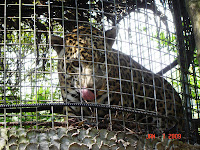 One won't see elephants or giraffes, but native Belizeans will tell you that before Sharon founded TBZ, some had never seen the animals of Belize. Many myths were taught to children about the animals. With Sharon's educational efforts, species in danger of extinction will be preserved, and the people of Belize have the opportunity to value these special animals rather than fear them. All the exhibits contain large areas full of the native rainforest plants and topography. The setting is as natural as it could be.
 One won't see elephants or giraffes, but native Belizeans will tell you that before Sharon founded TBZ, some had never seen the animals of Belize. Many myths were taught to children about the animals. With Sharon's educational efforts, species in danger of extinction will be preserved, and the people of Belize have the opportunity to value these special animals rather than fear them. All the exhibits contain large areas full of the native rainforest plants and topography. The setting is as natural as it could be.
 The highlight of the TBZ visit for me was a visit to see Cortland the Margay kitten. Cortland is not on exhibit, but she is being conditioned to have people enter her large enclosure to take photographs. She peacefully and regally sat in her tree perch while we took photo after photo. What an adorable and beautiful cat she is! And she is named after our college!
Our visit to TBZ certainly was memorable. In addition to seeing all the animals, we learned a great deal about the ecology of the area, and the conservation efforts that the zoo supports. I included photos of just a few of the many educational signs that are placed all over the Zoo grounds to give you a sense of the ubiquitous education. I hope you will be able to visit The Belize Zoo some time soon. "Cortland"
Our visit to TBZ certainly was memorable. In addition to seeing all the animals, we learned a great deal about the ecology of the area, and the conservation efforts that the zoo supports. I included photos of just a few of the many educational signs that are placed all over the Zoo grounds to give you a sense of the ubiquitous education. I hope you will be able to visit The Belize Zoo some time soon.
"Cortland"


 abandoned.
 burying another ceramic icon depicting a human in a crocodile's mouth. These two icons are pictured here, with a bit of the glare of the glass encasements from the museum center. I don't know about you, but if I were the Spanish back then, I would have taken these acts as a very clear rejection of their forced Christianity.


 in the height of the Classical period; there was climate change and lack of resources at a time of great population growth. The natural resources were stripped due to overpopulation.
 Yucatan Peninsula is Maya, and many are in Guatemala.


 Our cabin was up on stilts so that it sat up in the canopy of trees. It had a wonderful screened-in porch on two sides, and inside it had two double beds, a small counter area, and a small bathroom with a hot shower stall! The cabin had electricity, and it was wonderful to have a small refrigerator and lights to turn on at night. The cabin had a large jug of drinking water in it, and it was very clean and comfortable. At night and in the morning, with eyes closed, we could hear the sounds of the rainforest . . . birds, critters, tree frogs and crickets. It was a symphony of nature. The air is earthy and moist and fragrant. The whole atmosphere is rejuvenating.


